
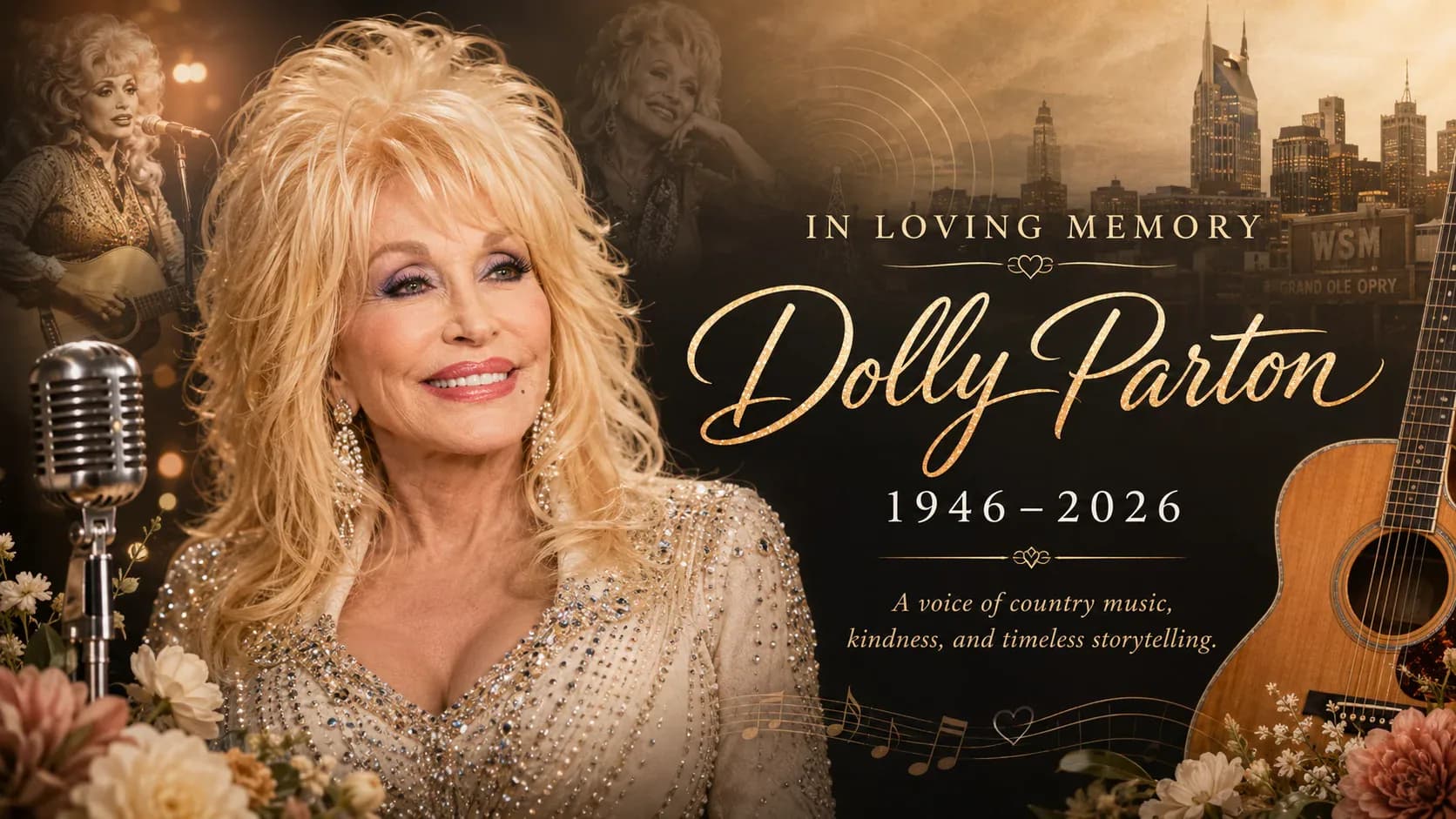
Dolly Parton, 1946–2026: The Voice That Never Left the Airwaves
Remembering the songwriter, storyteller, country music pioneer, philanthropist and unmistakable voice who made the world feel a little warmer. January 19, 1946 – August 25, 2026
There are famous voices, and then there are voices that somehow become part of home.
Dolly Parton had one of those voices.
For generations, she came through kitchen radios, car speakers, jukeboxes, record players, televisions and eventually streaming apps. Sometimes she arrived with heartbreak. Sometimes with humor. Sometimes with a story about a coat sewn from scraps, a woman named Jolene, a hard day's work, or the painful grace of knowing when it was time to say goodbye.
But wherever Dolly Parton's voice traveled, something unmistakably human traveled with it.
On August 25, 2026, Dolly Parton died in Nashville at the age of 80. Her passing closes one of the most extraordinary chapters in American popular music—a career that stretched for more than six decades and made a girl from the Tennessee mountains one of the most recognized and beloved entertainers in the world.
Yet saying that Dolly Parton was a country singer has always felt a little like saying the Smoky Mountains are hills.
Technically true.
And nowhere near enough.
A Girl From the Mountains With Something to Say
Dolly Rebecca Parton was born January 19, 1946, in rural East Tennessee, one of twelve children in a family that had little money but an abundance of music, stories and faith.

Long before the rhinestones, Hollywood premieres and sold-out arenas, there was a little girl fascinated by words and melodies.
She began writing songs as a child. By age ten, she was performing regularly on Knoxville's Cas Walker Show. At thirteen, she appeared on the Grand Ole Opry, where Johnny Cash introduced the young singer and she earned multiple encores.
Imagine that for a moment.
A thirteen-year-old girl from the Tennessee mountains standing on one of country music's most sacred stages, already carrying within her the beginnings of songs that millions of people had yet to hear.
After graduating from high school in 1964, Dolly headed for Nashville.
There were no guarantees waiting for her.
Just ambition, talent and songs.
Three years later came the opportunity that transformed her career: joining Porter Wagoner on his nationally syndicated television program in 1967. Their musical partnership made Dolly familiar to country audiences across America, but it would soon become clear that she was never destined to remain anyone's supporting act.
Dolly Parton had stories of her own to tell.
Then Came the Songs
Country music has produced extraordinary singers.
Dolly was something even rarer.
She was an extraordinary songwriter who happened to possess an unforgettable voice.
Her songs could be deceptively simple. A few chords. A melody you remembered after hearing it once. Words that sounded almost conversational.
Underneath that simplicity lived remarkable emotional precision.
“Coat of Many Colors” turned childhood poverty into dignity.
“Jolene” transformed jealousy and vulnerability into one of the most recognizable songs ever recorded.
“9 to 5” wrapped frustration with workplace inequality inside an irresistible pop-country anthem.
And “I Will Always Love You,” written as Dolly prepared to leave her professional partnership with Porter Wagoner, accomplished something extraordinary: it made goodbye sound loving rather than bitter.
Her first solo No. 1 country hit, “Joshua,” arrived in 1971. In 1974 alone, “Jolene,” “Love Is Like a Butterfly” and “I Will Always Love You” all reached No. 1.
Years later, Whitney Houston would transform “I Will Always Love You” into a global phenomenon of its own.
That is part of Dolly's genius.
The songs survived the singer.
They could leave Tennessee, leave country music, leave Dolly's own voice entirely—and still retain the emotional truth she placed inside them.
Her melodies crossed boundaries because the feelings inside them never required translation.
Dolly Parton and the Magic of Radio
For OndaCast, there is another part of Dolly's story especially worth remembering.
Dolly Parton and radio grew up together.
Not literally—but almost spiritually.
Her career emerged from the world in which a radio signal could carry a voice out of rural Tennessee and into homes hundreds of miles away.

The Grand Ole Opry itself began as a radio program on Nashville's WSM in 1925. Its powerful 50,000-watt signal eventually carried country music across enormous stretches of North America, helping turn Nashville into Music City and introducing generations of listeners to performers they might otherwise never have known.
Dolly first appeared on that Opry stage as a child and officially became an Opry member on January 4, 1969.
From then on, her music and radio became inseparable.
Think about how millions first encountered Dolly Parton.
They did not see the rhinestones.
They did not see the enormous blonde hair.
They did not see the famous smile.
They heard her.
A DJ announced her name.
A record began spinning.
And suddenly that remarkable Tennessee soprano was sitting beside someone driving a pickup truck through Kentucky, working the night shift in Ohio, preparing breakfast in Georgia, crossing Texas after midnight or tuning a little AM radio somewhere far beyond Nashville.
That was the extraordinary power of radio.
And Dolly was made for it.
Her songs didn't require spectacle. They created pictures inside your head.
Radio turned Dolly Parton from a performer on a stage into something more intimate: a storyteller sitting invisibly beside you.
For decades, country stations returned to those records again and again. New generations of DJs discovered them. New generations of artists covered them. New generations of listeners somehow found their own lives reflected in songs written years before they were born.
The technology changed.
AM became FM.
Records became CDs.
Broadcast signals met satellite radio, internet radio and streaming.
But somehow Dolly remained.
The platform changed. The connection didn't.
She Changed What a Country Woman Could Be
Dolly Parton also arrived in an industry where women were frequently expected to fit into carefully defined roles.
She did not.
She could be feminine without being submissive.
Funny without becoming a joke.
Ambitious without apologizing for ambition.
Deeply rooted in country tradition while refusing to be confined by it.
Alongside women such as Loretta Lynn and Tammy Wynette, Dolly helped transform opportunities for women in country music. She then pushed further—crossing into pop music, television, film and eventually rock while retaining the Appalachian voice at the center of her identity.
She understood something surprisingly modern decades before conversations about personal brands became commonplace:
You could control your own image.
You could own your work.
You could be commercially brilliant and artistically sincere.
You could let people underestimate you—and never make the mistake of underestimating yourself.
The exaggerated hair, nails, costumes and rhinestones became part of the Dolly mythology.
But behind all of it was an exceptionally disciplined songwriter and a remarkably savvy businesswoman.
She knew exactly what she was doing.
From Nashville to Everywhere

Eventually, country music could no longer contain Dolly Parton.
Neither could music.
She moved into Hollywood, starring in films including 9 to 5 and Steel Magnolias. She built Dollywood in East Tennessee, turning a major entertainment business into an economic engine tied closely to the region that raised her.
She moved across country, pop, gospel, bluegrass and rock while somehow sounding like Dolly in every one of them.
The awards followed.
Dolly entered the Country Music Hall of Fame in 1999 and the Songwriters Hall of Fame in 2001. The Library of Congress named her a Living Legend in 2004. She received the National Medal of Arts in 2005, Kennedy Center Honors in 2006 and the Recording Academy's Lifetime Achievement Award in 2011. In 2022, she joined the Rock & Roll Hall of Fame.
The Recording Academy lists ten Grammy wins and 55 nominations across country, pop, gospel, roots music and other categories—an unusually broad footprint for an artist whose beginnings were so firmly planted in Appalachian country music.
But awards explain only part of why Dolly mattered.
Her Greatest Legacy May Not Be a Song
For all the records sold, stages conquered and honors received, one of Dolly Parton's most remarkable accomplishments arrives not through a speaker at all.
It arrives in a mailbox.
In 1995, inspired in part by her father's inability to read and write, Dolly launched the Imagination Library in her home county in Tennessee.
The idea was wonderfully simple: send children a free book every month from birth until age five, regardless of their family's income.
What began with a little more than 1,700 books grew into an international literacy movement.
By 2023, the Imagination Library had distributed its 200 millionth book. Today, the program sends millions of books each month to children across the United States and other countries.
Think about the poetry of that.
A child born into poverty, who discovered that stories could carry her beyond the mountains, spent decades making sure millions of other children received stories of their own.
That may tell us more about Dolly Parton than any trophy ever could.
Her philanthropy extended well beyond literacy. She supported disaster relief in Tennessee and donated $1 million to research that helped support development of a COVID-19 vaccine.
She accumulated wealth.
Then she repeatedly found ways to send some of it home.
The Rare Celebrity Nearly Everyone Claimed as Their Own
Perhaps one of Dolly's strangest achievements was something no award committee could manufacture.
People simply liked her.
Across generations.
Across musical genres.
Across regions.
Across many of the cultural and political boundaries that increasingly divide American life.
She seemed capable of entering almost any room without demanding that everyone inside it first agree with one another.
Part of that came from humor. Part came from humility. Part came from an instinctive refusal to pretend she was better than the people listening to her.
She could laugh at herself while never diminishing herself.
There is an important distinction between the two.
Dolly understood it.
And people understood Dolly.
And Now, the Radio Plays On
Today, the news is painful.
There will be tributes. Special broadcasts. Memorial programs. DJs will reach for familiar records. “Jolene” will play. “Coat of Many Colors” will play. “9 to 5” will play.
And inevitably, “I Will Always Love You” will play.
Perhaps somewhere tonight, someone will hear one of those songs on the radio without knowing much about the woman who wrote it.
Maybe they will turn the volume up.
Maybe a child will ask who is singing.
Maybe someone who hasn't heard Dolly's voice in twenty years will suddenly remember a person, a place, a kitchen, a road trip or a little radio that once sat beside a bed.
That is the remarkable thing about recorded sound.
Artists leave us.
Their voices don't have to.
Dolly Parton began life in a small cabin in the Tennessee mountains and somehow sent her voice around the world.
She became a songwriter, singer, actress, entrepreneur, philanthropist and icon.
But underneath every title remained the thing she had been from the beginning:
a storyteller.
And storytellers receive a peculiar kind of immortality.
Every time someone presses play, the story begins again.
Every time a country station puts Dolly back on the air, a little piece of Tennessee travels through the atmosphere.
Every time someone sings one of her songs, opens one of the books her generosity placed in a child's hands, visits the mountains she never stopped loving, or decides that where they came from does not have to determine how far they can go, Dolly Parton's story continues.
So perhaps goodbye is not quite the right word.
Not for someone whose voice remains in millions of recordings.
Not for someone whose songs have already outlived generations.
Not for someone who spent eighty years leaving pieces of herself everywhere.
Today, we mourn Dolly Parton.
But more than that, we celebrate her.
The girl from the Smoky Mountains dreamed far beyond them—and then spent a lifetime reminding the rest of us that we could dream, too.
Thank you for the songs.
Thank you for the stories.
Thank you for the laughter.
Thank you for the kindness.
And thank you for all those years on the air.
Dolly Parton
January 19, 1946 – August 25, 2026
May the voice fade from the microphone, but never from the airwaves.